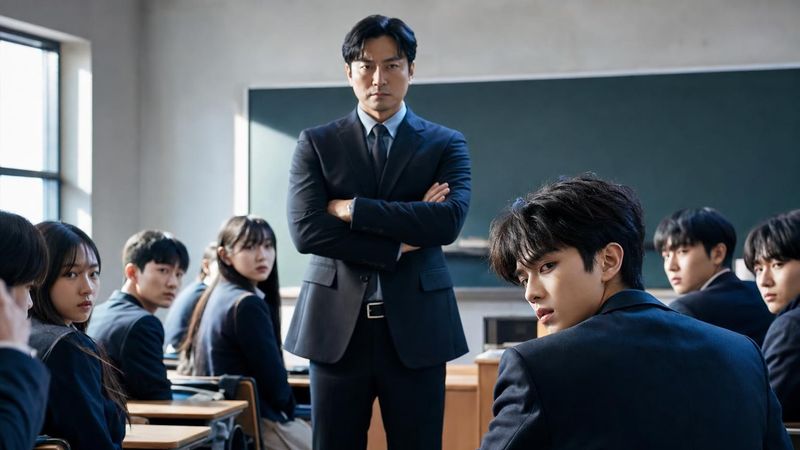
Teach You a Lesson, Netflix’s new Korean school action drama, shot to No. 1 on the streamer’s global non English TV chart within days of its June 5 premiere, logging 6.4 million views in three days. It has already entered Netflix’s Top 10 in over 85 countries, including the United States.
Behind the brutal classroom showdowns, though, the series has ignited a fight in Korea’s education world. Teachers and unions are split over whether the story glamorizes violence against students or finally forces the country to confront a school system they say is breaking down, fueling a fast growing Teach You a Lesson Netflix controversy.
Inside Netflix hit Teach You a Lesson and its brutal school justice
Based on the Naver webtoon Get Schooled, the 10 episode drama imagines a new government agency, the Educational Rights Protection Bureau, created to rescue schools where teachers have lost control. Inspector Na Hwa jin, played by Kim Moo yeol, is a former Special Forces captain legally allowed to use force to crush bullies, confront abusive parents and expose corrupt staff, helped by colleagues played by Lee Sung min, Jin Ki joo and idol actor Pyo Ji hoon of Block B.
According to Netflix’s companion site Tudum, Teach You a Lesson topped the global non English TV chart for June 1 to 7 and delivered this year’s highest opening week buzz score for a Korean Netflix title. The show even jumped into Western meme culture when John Cena posted Kim Moo yeol’s photo on Instagram, prompting the actor’s reply, “Now you can see me.”
Why Korean teachers are clashing over the drama’s message
An active Seoul middle school teacher surnamed Choi says the series correctly shows how “dire conditions” have become in some public schools, but worries viewers could think “violence against students is in some ways a necessary part of education.” A teacher at Gwangnam Middle School in Seoul called it an accurate portrait of classrooms, yet said the ending was “far too unrealistic” and that he wishes real schools had the same systems protecting teachers. On the anonymous workplace app Blind, another teacher wrote that relatives assumed the show must feel cathartic, but that she actually found it “horrifying.”
Korea’s largest teachers group, the Korean Federation of Teachers Associations, argues the drama resonates because it exposes broken classroom order, serious violations of teachers’ rights and a wave of malicious complaints from parents. The group cites 438 teacher rights cases in a year, including reports of “child abuse” for opening windows or stopping a student from slapping a classmate. “What this drama misses at its core is that what teachers need is not a fist, but legal protections,” the federation said, urging law changes.
From webtoon scandal to real policy talk
The backlash did not start with Netflix. The source webtoon Get Schooled was pulled from Webtoon’s English platform in 2023 after a chapter accused of “reverse racism” and racial slurs, and critics at home attacked its embrace of corporal punishment and portrayals of women and minorities. The Korean Teachers and Education Workers Union later issued a statement titled “Violence Is Not True Education,” urging producers to cancel the live action adaptation and warning that it normalizes banned corporal punishment and turns teachers into caricatures.
Responding to the criticism at its 2026 Korea showcase, Netflix executive Bae Jong byung said the team approached the series with a “strong sense of responsibility” and reworked the story through a “more considered and refined lens.” Reviews reflect that tension: Decider recommended streaming it as cathartic wish fulfillment for viewers furious about bullying and weak institutions, while South China Morning Post called the idea of a government squad using legal violence in schools “alarming” and said its message is unclear.
The show’s impact has already reached Korean politics, with a think tank linked to the ruling Democratic Party floating a real world version of the Educational Rights Protection Bureau, even as KFTA uses the moment to demand stronger legal shields for teachers inside existing schools. Kim Moo yeol says he mainly hopes viewers pause to reflect on what “true education” means, arguing that “if 10 people watch it, there are 10 different versions” of the story, a debate that is likely to keep growing as the series holds its spot on Netflix.