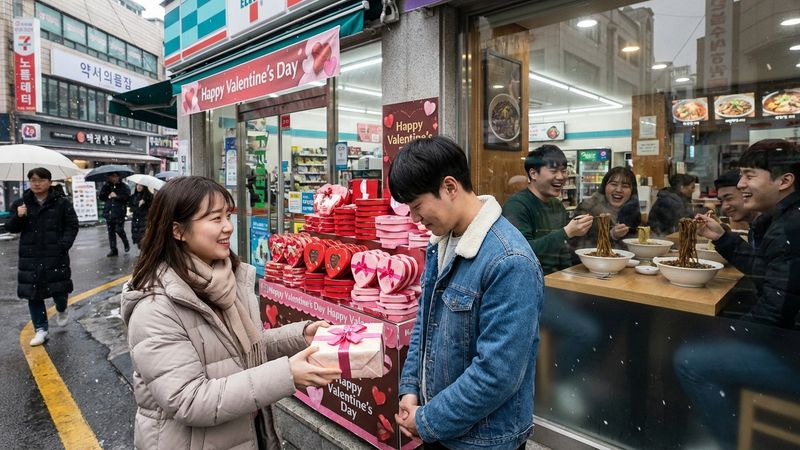
If you land in Seoul in mid February expecting men to be scrambling for roses and chocolates, the scene feels slightly off. Convenience stores stack heart shaped boxes to the ceiling, K-drama style photo booths pop up in malls, hotels push couple spa packages. Everything screams romance, yet the script behind Valentine’s Day in Korea is quietly flipped from what many Westerners know.
In South Korea, February 14 is only the opening act of a three part love calendar. Traditionally, women give chocolate to men that day, men answer one month later on March 14 for White Day, and singles claim April 14, Black Day, with bowls of jajangmyeon. Add in themed love days on the 14th of almost every month and curiosity grows fast.
How Valentine’s Day in Korea actually works
On February 14, it is women who are expected to take the lead. As one language site puts it: “In South Korea, only women give chocolate to men on this day.” 90 Day Korean explains this expectation in its guide. The date itself is not a public holiday, just a very visible one. Convenience stores and supermarkets roll out towering chocolate displays, ready made gift baskets and DIY kits, turning even small neighborhood shops into temporary Valentine corners.
Women usually divide their gifts into romantic and polite categories. High effort handmade or premium “honmei” chocolate goes to a boyfriend, husband or serious crush, while simpler “giri” chocolate can be handed to male colleagues, bosses or classmates out of courtesy. Chocolate still dominates, yet flowers, men’s skincare sets or small gadgets appear more often, and many modern couples now exchange presents both ways as brands market to all genders.
White Day, Black Day and Korea’s three step love cycle
Exactly one month later comes White Day, when men are expected to return the favor. Born from Japanese confectioners in the late 1970s, the Korean version features white chocolate, candies and many non edible gifts such as jewelry, lingerie, perfume, couple rings or electronics. Many men still follow the informal “rule of three,” aiming for a present worth roughly two or three times the Valentine’s gift they received.
Socially, White Day also works like a reply to a confession. A generous, thoughtful gift signals interest, a token gesture or silence often says there is none. Those who struck out twice move to April 14, Black Day, a light hearted singles gathering built around bowls of jajangmyeon, noodles in thick black sauce. Asia Society notes that for many Korean twenty somethings the cliché of miserable singles sharing noodles is “less reality, and more depressing hogwash.” Advertising around Black Day is minimal compared with February and March.
Monthly love days in Korea and the 14th date ritual
Beyond this February to April arc, Koreans have informally turned the 14th of many months into a themed date. Diary Day on January 14 sees some couples swap planners, Rose or Yellow Day on May 14 brings roses and yellow outfits, and June 14’s Kiss Day relaxes usual restraints on public affection. Not everyone marks every date, yet the idea of a year round romantic calendar is widely recognized in big cities.
- January 14 – Diary Day: swap planners or diaries.
- May 14 – Rose or Yellow Day: give roses, often yellow.
- June 14 – Kiss Day: couples share more open kisses.
- July 14 – Silver Day: exchange silver promise rings.
- October 14 – Wine Day: drink wine together at dinner.
- December 14 – Hug or Sock Day: hugs and sometimes warm socks.
- November 11 – Pepero Day: trade stick shaped chocolate snacks.
If you live in Korea, just mirror what friends and colleagues do. Small chocolates for male coworkers and a thoughtful White Day reply are enough, as many younger couples already bend or ignore older gender rules.