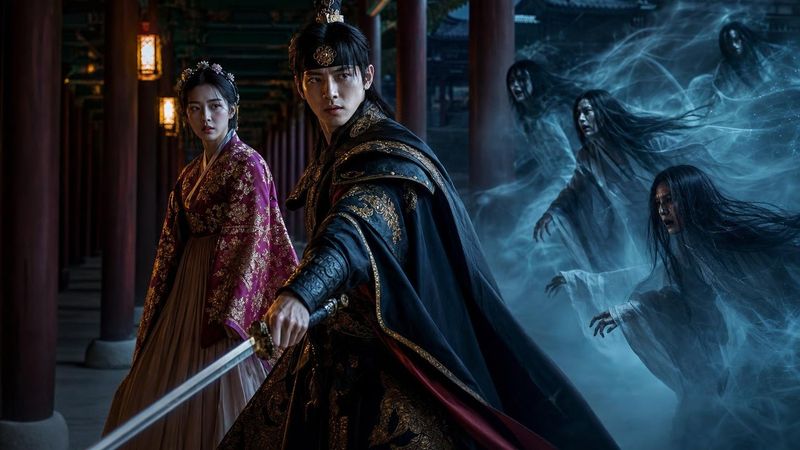
Netflix is betting hard on The East Palace, lining up the period horror series as its next global K-occult obsession as it drops worldwide on July 17 as an eight episode original. With a cursed royal residence, a spirit walking hero, and a court lady who talks to the dead, the show is already being positioned as the streamer’s next big genre play.
For fans who rode the wave of Sweet Home and recent box office hit Exhuma, the question is simple: can this palace horror fantasy repeat that breakout effect or will its rooted Korean shamanism make it a different kind of slow burn hit for global viewers?
What The East Palace Netflix K-drama Is About
The East Palace is a dark fantasy and occult period drama built around a deadly curse inside the Crown Prince’s residence. Nam Joo hyuk plays Gu cheon, a man who can cross between the living world and a perilous spirit realm, while Roh Yoon seo’s Saeng gang is a court lady with a secretive past and a rare sensitivity to ghosts.
Summoned in secret by the king, played by Cho Seung woo, the pair is ordered into the East Palace to untangle generations of mysterious deaths. The monarch has already lost most of his sons to the curse and described by Cho, he is “exceptionally solitary and lonely,” on the verge of losing his last remaining child.
The creative team is stacked: director Choi Jung gyu of The Devil Judge works with writers Kwon So ra and Seo Jea won, who previously built eerie supernatural worlds in The Guest and Bulgasal: Immortal Souls. Drawing on Korean folklore, they populate the palace with gwimae, ghostly monsters, and wongwi, vengeful spirits, while Gu cheon moves through the so called Realm of Gwi to confront them.
- Release: July 17, 2026, only on Netflix
- Episodes: 8
- Main cast: Nam Joo hyuk, Roh Yoon seo, Cho Seung woo
- Genre mix: occult, horror, fantasy, action, historical drama
Inside Netflix’s New K-occult Gamble
The timing of The East Palace is not accidental. Korean shamanism driven stories are having a moment, with films like Exhuma crossing 10 million moviegoers in Korea and critics talking about a “shaman wave” across dramas and movies.
Choi says the team referenced traditional folklore and oral tales, designing spirits that keep their original traits but feel intuitive for viewers everywhere. He also wanted to naturally showcase traditional palace attire and architecture while keeping the pacing fast enough that “anyone can thoroughly enjoy” it, regardless of culture or language.
For Netflix, the obvious benchmark is Sweet Home, the creature horror that became the first Korean series to enter the platform’s United States Top 10 and peaked at number three. The East Palace shares that high concept hook and genre savvy pedigree, and it is receiving a similar style of global marketing push, though whether it can match that kind of crossover footprint remains to be seen.
Why K-drama Fans Have Their Eyes on The East Palace
Beyond the occult hook, the series is a major comeback vehicle for Nam Joo hyuk, his first drama after a three year break for mandatory military service. He revealed that he read the script while still enlisted, saying the army gave him “many moments to stretch your imagination” and that he was ready to “burn myself out” to craft Gu cheon.
Roh Yoon seo is stepping into both her first historical fantasy and her first lead in a long form drama, admitting she was nervous but told herself, “let’s just dive into it and face the challenge. I’m bound to learn something.” Cho Seung woo brings gravitas as a king consumed by grief, anchoring the spectacle with raw emotion.
On the craft side, Choi pushed practical production to the limit, filming the same locations in different seasons, building separate sets, and using distinct color palettes so viewers can instantly tell whether they are in reality or the spirit realm, instead of leaning only on computer graphics. When The East Palace hits queues, global audiences will see whether that mix of shamanic horror, royal tragedy, and physical worldbuilding sparks the next Sweet Home style genre moment.