The hit revenge K-drama Agent Kim Reactivated is packed with car chases, explosions, and a dad on a mission. What many viewers might not realize is that one of its biggest set pieces was never actually filmed with cameras at all.
In the opening episodes, a three-minute mission in North Korea plays out as the first fully AI-generated action sequence ever broadcast in a Korean drama, created by Morpheus Studio for SBS and Netflix. That experiment puts the series right in the middle of the global conversation about how far AI should go in film and TV.
What is Agent Kim Reactivated, and where does the AI scene fit?
Agent Kim Reactivated (Korean title 김부장) is a revenge action thriller based on the Naver webtoon Manager Kim. So Ji-sub plays Kim Do-hyeon, a former covert operative who has settled into life as a mild-mannered bank employee and single dad, until his daughter is kidnapped and he is forced to tap back into his lethal past.
The drama, often compared by critics to franchises like Taken, John Wick, and Reacher, premiered on SBS on June 26, 2026, in the Friday-Saturday primetime slot, and it streams on Netflix. It opened with a strong 9.5 percent nationwide rating in Korea, jumped to 15.7 percent by episode 2, and crossed 20 percent by episode 4, making it one of SBS’s fastest-climbing recent hits.
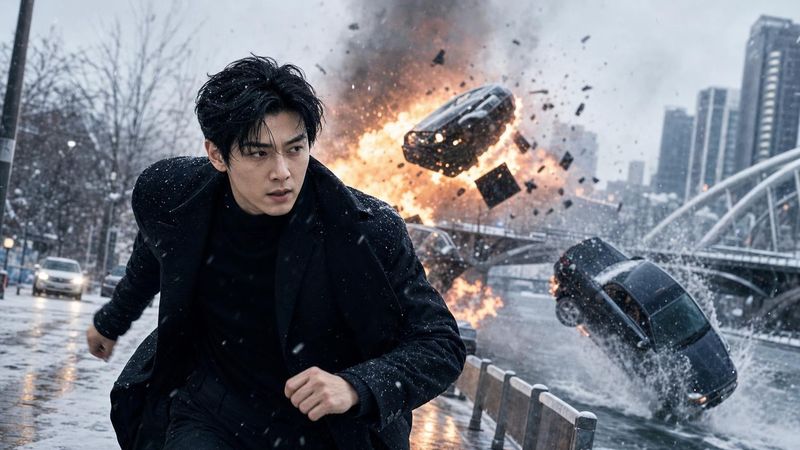
The Agent Kim Reactivated AI action scene appears in the first two episodes, as a flashback to Kim’s years as a black-ops agent operating between North and South Korea. Instead of staging a huge international-style set piece, the production chose to build the entire sequence with AI, with no live-action footage involved.
- Kim blowing up a building during a covert mission
- Car chases on snow-covered roads and through tunnels
- A vehicle overturning and crashing into a river
- Gunfights and hand-to-hand combat
- Close-up shots of So Ji-sub’s character in the middle of the chaos
All of that was generated digitally. For viewers, the scene plays as a key piece of backstory that explains just how dangerous Manager Kim used to be, while quietly marking a first in K-drama production history.
How Morpheus Studio built a story-critical AI action sequence
The sequence was created by Morpheus Studio using its in-house AI content platform AICRON. Instead of a traditional VFX pipeline that starts from filmed plates, AICRON takes text prompts and runs them through an integrated, node-based system that handles image and video generation, audio, and editing in one interface, powered by multiple commercial AI models.
Morpheus vice president and veteran VFX supervisor Ryu Jae-hwan oversaw the work. Ryu said the significance was that the team used AI to produce an entire “story-critical” sequence, not just touch up a few seconds of effects shots. From the beginning, the drama was planned with AI in mind, which made it possible to design an ambitious mission that still fit a broadcast drama budget.
The production notes explain that shooting the same material practically would have meant costly overseas-style locations, large sets, pyrotechnics, and heavy conventional VFX. With AICRON, the team also aimed to minimize one of the biggest problems in AI video: characters whose faces change from shot to shot. They say the system kept So Ji-sub’s likeness and expressions stable even during fast, complex action.
On social media, Morpheus Studio framed the project as proof that Korean AI tech can now deliver “commercial-quality video.” Korean media reports cited in early coverage describe audience reaction to the visuals as generally positive, with little criticism about awkward or uncanny images, which will only encourage other producers to pay attention.
Why this AI experiment is fueling a bigger K-drama debate
Globally, generative AI is already one of the most argued-over topics in entertainment, tied to Hollywood labor disputes, deepfake worries, and questions about who controls an actor’s face. That is why a ratings hit like Agent Kim Reactivated using AI for a full narrative action scene, not just a background effect, feels like a line in the sand for many viewers and industry insiders.
On the upside, producers see clear advantages. AI lets them stage set pieces that would be difficult or dangerous to film, from icy roads to river crashes, without putting stunt teams at risk. It can contain costs for webtoon adaptations where massive explosions and high-speed chases are built into the original panels, while still delivering something that looks big enough for a global Netflix audience.
The concerns sit on the other side of that equation. If AI can handle a snowy car chase without extras, stunt performers, or location crews, some worry that future projects could lean on it in ways that cut into real-world jobs. There are also questions about how actors should be compensated and protected when their likeness is synthesized by AI for scenes that they never physically performed.
For K-drama fans, the deeper issue is emotional authenticity. Part of the genre’s appeal has always come from actors and stunt teams pushing themselves in tightly shot action and melodrama. Experiments like the Agent Kim Reactivated AI sequence raise open questions: how much AI is too much, when does it start to feel less “real,” and will viewers accept more of these sequences if the story and performances around them still hit hard?
As Agent Kim Reactivated continues its run on SBS and Netflix with a staggered two-episodes-per-week release, it functions as a live test case. Other action-heavy webtoon adaptations, broadcasters, and streamers will be watching those ratings and reactions closely to decide whether this kind of AI-driven action remains a one-off experiment or becomes a new tool in the standard K-drama playbook.