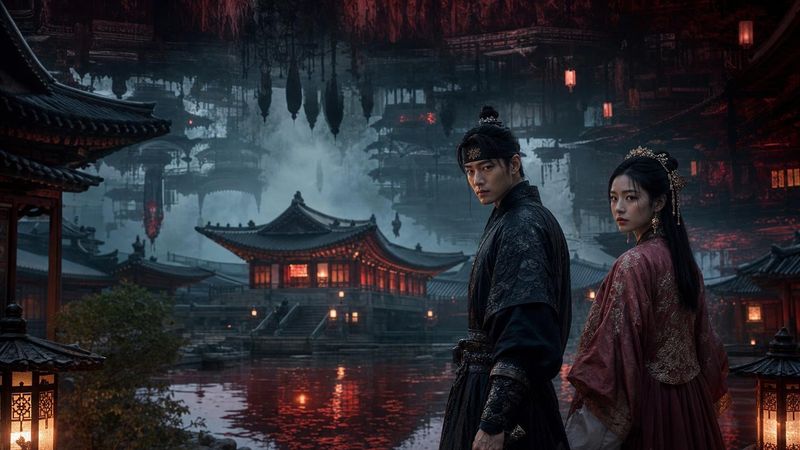
The East Palace is the rare K-drama horror series that does not just add ghosts to a palace, it treats the entire royal court as a cursed machine and asks what kind of cruelty would create so many spirits in the first place. Marketed as a dark fantasy occult thriller for Netflix, the show follows a ghost-slaying swordsman and a court lady who hears the dead as they hunt a curse wiping out the king’s bloodline.
For US viewers used to zombie plagues in Kingdom or creature attacks in Sweet Home, this K-occult story hits different. The East Palace blends Korean shamanism, a parallel spirit realm and ruthless Joseon palace politics, and early Korean reviews argue that its real monster is not a demon at all, but power itself.
What Sets The East Palace K-drama Apart
On paper, The East Palace sounds like classic sageuk horror. Multiple crown princes turn up dead near a palace pond, and rumors spread that a vengeful pond spirit has returned to erase the king’s entire bloodline. Shaken out of his skepticism, the king secretly summons Gu-cheon, played by Nam Joo-hyuk, a rogue swordsman able to cross into the world of spirits and hunt what lives there.
Gu-cheon is paired with Saeng-gang, a young court lady portrayed by Roh Yoon-seo, who has the terrifying ability to hear the dead. Together they investigate a curse that seems centered on the East Palace, the residence of the crown prince, while hiding their mission from officials who would rather bury the truth than admit the court is haunted.
The eight episode series, written by Kwon So-ra and Seo Jae-won and directed by Choi Jung-kyu, is firmly in the K-occult lane the writers helped build with The Guest and Bulgasal: Immortal Souls. Those earlier shows mixed shamanic rituals, folk spirits and long-running curses in modern settings. This time, they transplant that mythology into the most rigid power structure in Korean history, the Joseon palace.
It is also Nam Joo-hyuk’s first major drama after military service, which gives the Netflix project extra visibility beyond horror fans. Instead of a warm romantic lead, he plays an outcast demon slayer moving between two realities, which helps sell the series as a prestige genre experiment rather than just another spooky period piece.
A Joseon Gothic Palace Where the Real Monster Is Power
Visually, The East Palace leans into what Korean critics call “Joseon Gothic.” The show constructs a second version of the palace, a spirit world that overlaps the real courtyards and corridors. Like the Upside Down in Stranger Things or the hellscape version of Los Angeles in Constantine, this realm mirrors familiar spaces but twists gravity, light and atmosphere into something nightmarish.
Gu-cheon fights vengeful ghosts in that alternative palace, while Saeng-gang navigates the living one, listening to whispers from the dead. Yet the Korea Times review argues that the most chilling element is how the royal court treats its own people. Court ladies, servants and political rivals are shown as disposable, crushed by etiquette and intrigue until death starts to look like the only exit.
In that reading, the curse is almost a symptom. The series frames the East Palace as a place where accumulated resentment, or han, naturally turns into spirits because the powerless have no other way to speak. Those who manipulate them, from aristocrats to palace officials, become more frightening than any pond demon.
- Political horror: a system that sacrifices the weak to protect the throne.
- Spiritual horror: ghosts born from injustice and unresolved grief.
- Visual horror: a palace doubled by its own decaying reflection, the spirit world.
Even the drama’s opening threat, “I will wipe out the king’s entire bloodline,” hits differently when the palace already feels like a beautiful prison. The exorcism plot turns into something closer to rebellion, with Gu-cheon and Saeng-gang cutting through both spirits and a hierarchy that would rather see them dead than let the truth surface.
How The East Palace Could Change K-Occult Horror
K-occult dramas use Korean shamanism, folk tales, Catholic exorcism and the idea of han as their emotional engine. In The Guest, that meant a demon tied to past atrocities. In Bulgasal, it meant a 600 year curse binding reincarnated souls. The East Palace keeps those elements, but compresses them into a tight eight episode season designed for global binge watching on Netflix.
Instead of biological horror like Kingdom or body horror creatures, this series leans into what some critics describe as “administrative horror.” The terror comes from institutions that are supposed to manage both life and death, but fail. The Joseon court covers up crimes to preserve the dynasty, and the spirit realm, called the world of ghosts or Realm of Gwi in other materials, looks like a backlog of unresolved cases.
For US viewers, that structure may feel fresh. The co-existing palaces, one living and one dead, echo Western fantasy but are rooted in Korean beliefs about parallel worlds and restless spirits. The show’s creators and cast have also stressed that the series is scary and intense, yet calibrated so even people who usually avoid gore can still follow the story, with more emphasis on atmosphere, rituals and dread than on graphic violence.
Put together, those choices give The East Palace a chance to push K-occult into the mainstream in a way earlier cable dramas could not. It arrives years after Kingdom opened global doors for Joseon horror, and local coverage has already framed it as the project finally filling that gap on Netflix. Whether viewers come for Nam Joo-hyuk’s comeback, the palace intrigue or the meticulously built spirit world, the series shows how K-horror can evolve from jump scares into something darker and more systemic.