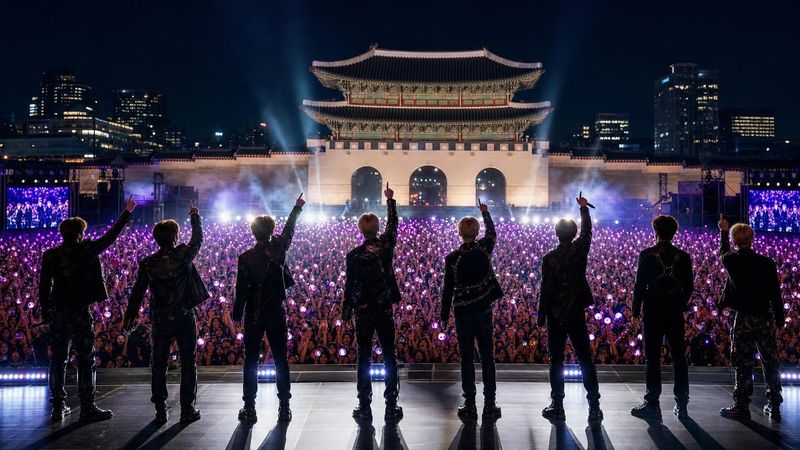
On March 21, 2026, BTS turned Seoul’s Gwanghwamun Square into an hour long comeback show, BTS THE COMEBACK LIVE | ARIRANG, streamed on Netflix to more than 190 countries. Japanese users on X have been replaying the performance and asking how a boy group ended up in the middle of a government plaza.
For many of them, this was not just another K-pop spectacle. The ticketed concert shut central roads for about 33 hours, triggered disaster style safety alerts on smartphones, and leaned heavily on city resources, a mix of civic power and private entertainment that is now fueling cross border arguments.
How BTS Turned Gwanghwamun Into a Global Stage
BTS, the seven member group under Big Hit Music with fandom ARMY, fills arenas, not protest squares. Netflix said about 18.4 million subscribers watched the livestream, turning the square in front of Gyeongbokgung Palace into a highly visible stage for Korean culture.
City officials handled the show almost like an emergency drill, restricting traffic and blasting mobile disaster alerts about road closures and crowding. An AI analysis of 1,527 X posts in nine languages by consulting firm Ars Praxia found “safety” among the top foreign language keywords, with one Thai user writing, “I was surprised when I received this kind of notification on my phone.”
Why Japanese Social Media Is Shocked by the Show
Within that dataset, 355 posts were in Japanese, the second largest group after English, and much of the BTS Gwanghwamun Japanese reaction sounded like policy debate, not fan squealing. Users criticized companies letting staff leave early for what one called “not even a public project,” and asked whether taxpayers were covering police, roadblocks and other support for a Netflix and HYBE concert.
Others questioned using Gwanghwamun, asking why a pop event belonged in front of the palace. Professor Lee Chang min likened the square to Kasumigaseki or the plaza outside Tokyo’s Imperial Palace, where a similar show would be “almost impossible.” At the same time, some posts admired the idea of turning a city center into a venue, while wondering if any local artist could draw 100,000 fans there.
Korean, Japanese and Global Fans Are Seeing Different Things
Ars Praxia also looked at 472 Korean language posts and found 121 that complained about disruption to daily life, public money and the decision to use the square. Foreign language posts leaned the other way, with 159 mentioning Gwanghwamun’s history or symbolism, and researcher Hong Min jung noting how often the English keyword “historical” appeared as fans framed the night as a “historic event.”
That framing echoed President Lee Jae Myung’s X message praising BTS as “artists who make Korea proud” and celebrating “the appeal of K-culture, with ‘Arirang’ as its theme.” Fans translated the post and circulated it widely. With BTS THE COMEBACK LIVE | ARIRANG now on Netflix replay, debates over who controls public squares, who pays for large scale K-pop shows and why Korea has succeeded where Japan’s “Cool Japan” push stalled are likely to keep spreading beyond Seoul and Tokyo.