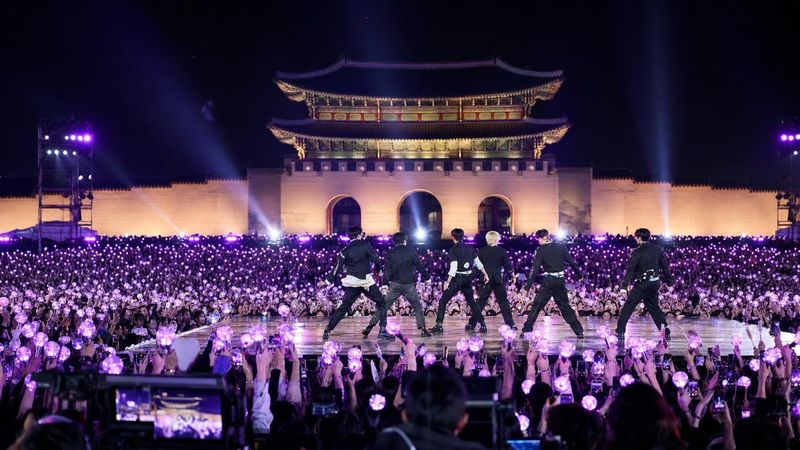
On March 21, 2026, BTS turned Seoul’s Gwanghwamun Square into a free comeback concert, BTS THE COMEBACK LIVE | ARIRANG, streamed on Netflix to more than 190 countries. Within hours, the BTS Gwanghwamun concert was all over Japanese social media, not just as a cool K-pop moment but as something almost unimaginable at home.
For Korean residents, the show meant 33 hours of road closures, emergency-alert texts and a fierce debate over whether a private HYBE and Netflix event should occupy the capital’s civic square. For many Japanese users watching via X, it instantly raised a different question: could their own government district ever be handed to an idol group in the same way?
BTS Turned Gwanghwamun into a Global Comeback Stage
Gwanghwamun Square sits in front of Gyeongbokgung Palace, surrounded by government offices and protest routes, so turning it into a glowing purple stage already felt historic. Netflix beamed the comeback to 18.4 million subscribers worldwide, while President Lee Jae Myung posted that BTS are “artists who make Korea proud” and hoped the event would share Korea’s cultural heritage with the world.
Koreans were flooded with push alerts as authorities warned of traffic controls around the square. A Thai visitor on X admitted being “surprised” to get a disaster-style message about a BTS show, a post that drew 2,898 reposts and made the alert system part of the spectacle. In a sample of 200 posts about the on-site mood, researchers found “safety” in 51 of them, showing how tightly people linked the concert to state-level crowd control.
Researchers at Ars Praxia analyzed 1,527 posts in nine languages from March 18 to 24. Among 472 Korean-language posts, 121 criticized disruption, public resources or the decision to use the square, reflecting worries of commuters who treat Gwanghwamun as everyday infrastructure rather than a pop stage.
Why Japanese Social Media Asked if This Could Happen in Tokyo
Japanese-language posts were especially intense: 355 of them appeared in the dataset, second only to English. Users questioned why companies near the venue were sending staff home early “when this is not even a public project,” and asked how Netflix fit into the revenue picture if taxpayers were supporting police and traffic control.
Others wanted to know “why they are trying to hold a concert in Gwanghwamun,” echoing Korean debates in real time. Many Japanese users are familiar with central Seoul, so they compared what they saw on screen with their own city layouts rather than treating it as a distant K-pop fantasy.
Hankuk University professor Lee Chang-min explained that the closest Japanese equivalents would be Kasumigaseki, Tokyo’s government district, or the plaza in front of the Imperial Palace. He said a commercial concert in either space would be “almost impossible,” which helps explain the online shock. Korea University professor Hosaka Yuji added that Japanese culture is unusually sensitive to “what is public” and to causing inconvenience, so the controversy around the square’s use landed hard.
K-pop Soft Power, Cool Japan and What Comes Next
Some Japanese commenters praised the concept, calling it an “excellent idea to turn an entire city center into a live concert venue,” while doubting Japan has an artist who could pull 100,000 people worldwide at once. That fed into longer running talk about K-pop as a model content industry, contrasted with Japan’s “Cool Japan” policy, which many there view as a failure.
Foreign-language posts tended to treat the show as nation branding, not just fandom. In 159 posts, users mentioned the history or symbolism of Gwanghwamun, and the English word “historical” appeared again and again. A clip of the crowd singing the folk song “Arirang” together reached 8,502 reposts, while translations of President Lee’s message averaged 3,348 reposts, the highest among foreign posts.
The study suggests that Koreans mainly saw “the square,” a piece of public infrastructure that suddenly shut down, while overseas users saw “Korea,” a cultural superpower projecting itself through BTS. For a seven-member group that already tops Billboard charts and speaks at the United Nations, the Gwanghwamun show has become a template for how future K-pop comebacks might literally reshape a city skyline in real time.