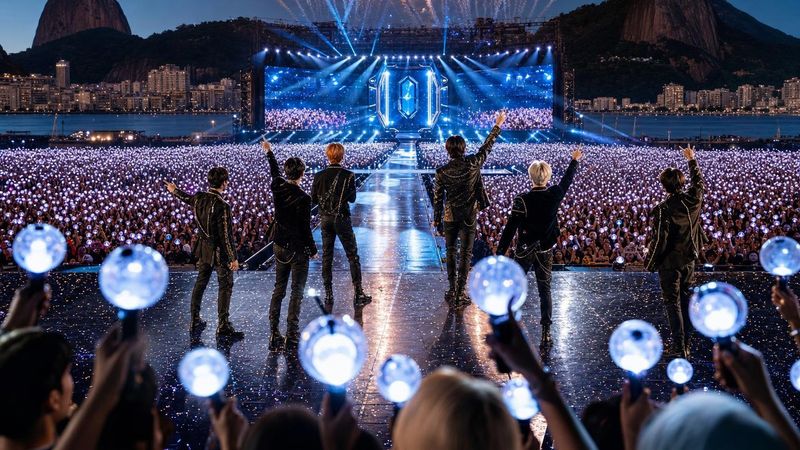
Stray Kids Rock in Rio became a landmark K-pop festival moment on September 11, when the eight-member group headlined Rio de Janeiro’s Palco Mundo for a reported 100,000-person crowd. JYP Entertainment said Stray Kids are the first K-pop act ever to headline Rock in Rio, turning the festival’s first K-pop-focused night into a massive showcase for STAY culture.
The scale matters beyond one loud Brazil concert. Rock in Rio did not simply add a K-pop name to its lineup: the festival allowed fans to bring lightsticks into the venue for the first time since its 1985 launch, a change that made Stray Kids’ signature audience experience part of one of music’s most established global stages.
Stray Kids made Rock in Rio history
Stray Kids closed the World Stage at Rio de Janeiro Olympic Park on Friday, September 11, with the performance extending just past midnight into September 12 local time. The group headlined a bill that also included global pop names such as Calvin Harris, the Black Eyed Peas, Maroon 5, and Elton John.
JYP reported an audience of 100,000 for the set, while Brazilian outlet G1 Globo reported that 100,000 tickets for the event night had sold out. That does not mean every person in attendance was a STAY, but coverage from the grounds made clear that Stray Kids’ fandom was a dominant force across Cidade do Rock.
Bang Chan, Lee Know, Changbin, Hyunjin, Han, Felix, Seungmin, and I.N. arrived as the night’s most anticipated act. Fans filled the grounds with custom lightsticks, group shirts, handheld fans, chants, and dance moves, creating the kind of participatory atmosphere that is central to a K-pop arena show but less common at a multi-genre festival.
For Stray Kids, the headline slot placed their hard-hitting performance style at the center of a legacy festival rather than on a separate K-pop-specific stage. That distinction is the core of the milestone: Palco Mundo was not just hosting a guest appearance. It handed its closing spot to a Korean act.
Why STAY lightsticks changed the festival
The lightstick decision was one of the clearest signs that Rock in Rio was prepared to meet K-pop fans on their own terms. JYP said the festival permitted lightsticks in recognition of K-pop concert culture, marking the first time they had been allowed since Rock in Rio began in 1985.
At a Stray Kids show, lightsticks are more than accessories. They turn a huge crowd into a visible part of the production, responding to the music and giving fans a collective role in the room. At Rock in Rio, that lightstick ocean made the audience impossible to treat as background.
The festival also used an extended runway that allowed the members to move closer to fans beyond the usual Palco Mundo setup. The group addressed the crowd in Portuguese with phrases including “Faz barulho,” “Pula,” and “Caraca,” while other remarks in English and Korean were delivered with simultaneous Portuguese translation.
That approach helped make a large outdoor event feel more like an exchange than a one-way set. Before the festival, the members told Billboard Brasil, “We’ll make sure there’s a lot of passion.” The response in Rio, from the constant singing to the illuminated crowd, matched that promise.
Inside the Stray Kids Rock in Rio set
Rather than relying on a single era, the reported Stray Kids Rock in Rio setlist highlights moved through different chapters of the group’s catalog. “DOMINO” and “BOUNCE BACK” opened an early high-energy stretch, followed by tracks including “Thunderous,” “MANIAC,” “God’s Menu,” “S-Class,” “LALALALA,” and “Chk Chk Boom.” Songs from the current This & That era were also part of the performance.
The show leaned into the sound that has made Stray Kids stand out at large festivals: heavy electronic beats, rap, forceful vocals, sharp choreography, and a live band with bass, guitar, drums, and keyboards. Fireworks, pyrotechnics, and lighting pushed the set’s final section into full festival-headliner mode.
The visual concept changed with the music. In the opening stretch, the members wore blue, black, and white streetwear-inspired looks built around athletic pieces, jeans, tank tops, and accessories. Later, during “DIVINE” and “God’s Menu,” they switched into predominantly white outfits with Korean-inspired elements, while dancers wore coordinated black-and-white looks with hats and long fabric sashes worked into the choreography.
Brazil was woven into the show without taking attention away from Stray Kids’ own identity. During “Chk Chk Boom,” the members tried samba steps onstage. Bang Chan later sang part of Michel Teló’s Brazilian hit “Ai Se Eu Te Pego,” and the crowd immediately joined in, giving the closing stretch a local touch that felt designed for Rio rather than copied from another tour stop.
From Bogotá to Rio to STRAYCITY
Rock in Rio arrived in the middle of a bigger Latin American run. Stray Kids launched their new STRAYCITY festival tour in Bogotá on September 9, two days before the Rio headline appearance. The project is co-produced by JYP Entertainment and U.S. concert company Live Nation, with local artists and JYP’s multinational boy group NEXZ also scheduled to appear.
The chronology matters because it frames Rock in Rio as part of a regional push, not an isolated invitation. After Bogotá and Rio, STRAYCITY moves to Buenos Aires for shows on September 14 and 15, then continues to Mexico City on September 25 and 26.
- September 9: Bogotá, Colombia
- September 11: Rock in Rio, Rio de Janeiro, Brazil
- September 14 and 15: Buenos Aires, Argentina
- September 25 and 26: Mexico City, Mexico
Stray Kids had already tested their festival strength on major U.S. stages, including Lollapalooza Chicago and New York’s Governors Ball. Rock in Rio, however, raised the stakes by placing them at the top of a festival program built around K-pop and adapting its crowd policies to support the genre’s distinctive concert culture.
What STAYs should watch next
The immediate focus is on how the Buenos Aires and Mexico City STRAYCITY dates build on the momentum from Brazil. Those shows will offer the clearest next measure of how Stray Kids’ festival-scale presentation travels across Latin America, especially with Live Nation involved in the tour’s production.
Fans will also be watching for official Rock in Rio performance clips, backstage photos, and a fuller record of the set. The reported song list captures key moments, but a complete official setlist was not provided in the available material.
The larger open question is what this means for Rock in Rio’s future programming. Its first K-pop-focused night ended with a reported 100,000-person crowd, a lightstick-filled World Stage, and Stray Kids as the festival’s first K-pop headliner. Future editions will show whether that breakthrough becomes a one-night milestone or the beginning of a regular place for K-pop at the festival.