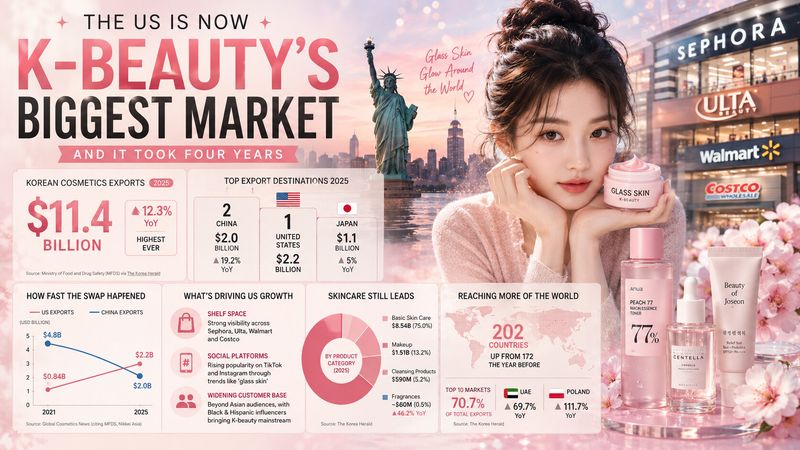
For most of the last decade, the answer to “who buys the most Korean cosmetics?” was China, and it was not close. That is no longer true. The United States is now the largest export market for K-beauty, and the shift happened inside four years.
The numbers
Korean cosmetics exports reached $11.4 billion in 2025, up 12.3 percent year on year and the highest annual total on record, according to figures from South Korea’s Ministry of Food and Drug Safety reported by The Korea Herald.
The destination breakdown is where the story is:
- United States — $2.2 billion
- China — $2 billion, up 19.2 percent
- Japan — $1.1 billion, up 5 percent
Note that China grew, and still lost the top spot. It was overtaken because the US grew faster from a much lower base.
How fast the swap happened
Global Cosmetics News puts the trajectory in plain figures. US exports went from $841 million in 2021 to $2.2 billion in 2025 — more than doubling. Over the same period, exports to China fell from around $4.8 billion to $2 billion.
Put those side by side and the scale of the reversal is clear: China’s K-beauty imports lost more value in four years than the entire US market was worth at the start of the period.
What is driving the American side
Global Cosmetics News attributes the US growth to three things working together.
Shelf space. Growth is “driven by strong visibility across retailers such as Sephora, Ulta Beauty, Walmart and Costco”. That range matters — it spans prestige beauty and warehouse retail, meaning K-beauty is no longer confined to a specialist niche or an import shop.
Social platforms. The same report cites “rising popularity on TikTok and Instagram through trends like ‘glass skin'” — a case of a Korean beauty concept becoming a search term in its own right, then pulling product demand behind it.
A widening customer base. Perhaps the most significant line: “the consumer base is also expanding beyond Asian audiences, with Black and Hispanic influencers helping bring K-beauty into the mainstream.” A category that grows past its diaspora market is a category with a different ceiling.
And the Chinese side
The decline was not purely demand-led. According to Global Cosmetics News, Korean brands “have actively diversified away from China following geopolitical tensions and changing market conditions” — a strategic retreat as much as a lost market. The publication credits Nikkei Asia as the origin of the comparison.
Skincare still carries the category
The product split reported by The Korea Herald shows how concentrated K-beauty remains:
- Basic skin care — $8.54 billion
- Makeup — $1.51 billion
- Cleansing products — $590 million
- Fragrances — around $60 million, but growing 46.2 percent
Skincare is roughly three quarters of the total. Fragrance is a rounding error by value — and the fastest-growing line on the list, which is worth watching over the next few years.
The quieter number
One figure in the Korea Herald report deserves more attention than the headline totals: Korean cosmetics were exported to 202 countries in 2025, up from 172 the year before. The top ten destinations accounted for 70.7 percent of the total, meaning the remaining 192 markets are still small — but thirty new countries in a single year describes distribution reaching places it had not before.
The outlier growth rates sit there too: the UAE up 69.7 percent, Poland up 111.7 percent.
The Ministry of Food and Drug Safety framed its own position modestly, saying it will “keep working to ensure that high-quality Korean cosmetics remain competitive and continue to grow in markets around the world.”
Why this matters for fans
For readers outside Korea, the practical consequence of these numbers is availability. A category selling $2.2 billion a year into the US through Sephora, Ulta, Walmart and Costco is a category where the products idols actually use are increasingly stocked locally, rather than ordered from overseas and waited on for weeks. The export figures are, in the end, a proxy for how easy it has become to buy the thing.