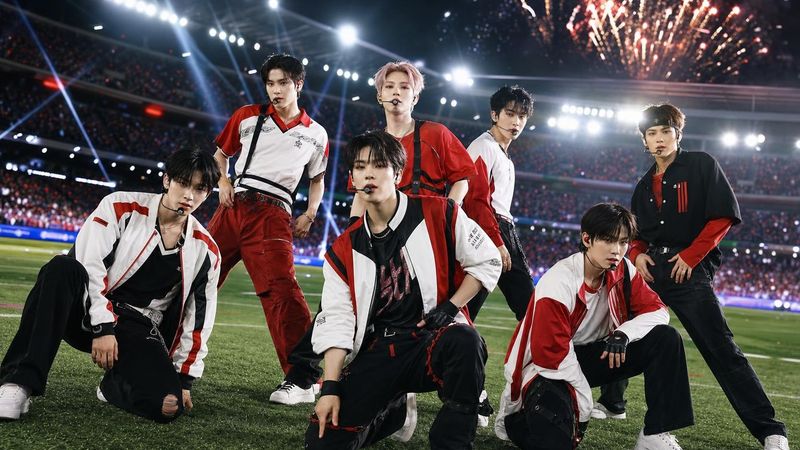
BTS at the 2026 World Cup final marked a new kind of global-stage milestone for K-pop. After closing the European leg of the ARIRANG World Tour at Paris’ Stade de France, the seven members traveled to East Rutherford, New Jersey, to perform Dynamite during FIFA’s first World Cup final halftime show.
The performance was brief, but its place in BTS history is easier to understand when viewed alongside the group’s Paris stadium return, Dynamite’s U.S. chart legacy, and Jung Kook’s earlier World Cup appearance. It was not simply a one-song guest spot. It placed BTS alongside pop stars who have defined global event television for decades.
BTS brought Dynamite to the World Cup final
BTS performed at the Spain versus Argentina FIFA World Cup final on July 19, 2026, at New York New Jersey Stadium in East Rutherford. The event was billed as the first halftime concert staged at a World Cup final, bringing a Super Bowl-style music format to football’s biggest match.
Within a halftime production reported to run for about 11 minutes, BTS delivered an alternate arrangement of Dynamite in coordinated red, white, and black looks. Their segment lasted roughly two minutes, following Madonna’s opening sequence and leading into later appearances from Shakira and Burna Boy.
Coldplay frontman Chris Martin curated the lineup, which also included Madonna, Shakira, Justin Bieber, and Burna Boy. FIFA and Global Citizen partnered on the production, which promoted the FIFA Global Citizen Education Fund and its reported $100 million fundraising goal for children’s education and football programs.
For casual viewers, the song choice offered an immediate entry point. Dynamite is BTS’s first Billboard Hot 100 No. 1, and it spent three weeks atop the chart in 2020. Bringing that English-language hit to a U.S. stadium gave the group a familiar, high-energy anthem for a worldwide television audience.
Why Dynamite carried BTS’s U.S. legacy
Dynamite has long represented BTS’s crossover reach, but its World Cup placement gave the song a different purpose. Rather than functioning as a comeback single or an awards-show performance, it became BTS’s introduction to a sports audience that extended far beyond a typical K-pop broadcast.
The track’s singalong hook and bright pop structure fit the compressed format of a halftime set. BTS had only a limited window on the pitch, so a song with immediate recognition made sense beside a lineup designed for viewers across different regions, languages, and music scenes.
FIFA listing BTS alongside Madonna and Shakira also mattered. The group was positioned as a main headliner at an event built around established global pop names, not as a specialty act added solely for K-pop fans. That distinction reflects how major sports productions increasingly treat Korean artists as central programming.
BigHit Music said BTS were honored to participate and highlighted music as a universal language of hope and unity. That message aligned with the event’s education-fund mission, while the performance itself showed how a BTS hit from 2020 could still carry a stadium-scale cultural meaning years later.
The Paris ARIRANG finale showed BTS at stadium scale
The World Cup appearance came directly after BTS’s two-night Stade de France run in Paris on July 17 and 18. The concerts were the group’s first full-group Paris stadium return since 2019, giving the ARIRANG era one of its most emotionally loaded tour stops.
Reporting placed the first-night audience between about 88,000 and 92,000 people, depending on the account. Onstage, BTS called it the biggest concert crowd in their history, a claim that captured the scale of the night even though the exact attendance figure has not been consistently reported.
The Paris show used a 360-degree stage and cross-shaped runways to bring BTS toward every part of Stade de France. Its 23-song format paired newer ARIRANG material with staples including Run BTS, MIC Drop, IDOL, Butter, and Dynamite.
That made the transition to New Jersey feel less like a separate detour and more like a continuation of the tour’s stadium ambition. Paris emphasized the group’s ability to carry an entire night of music, production, and fan connection. The World Cup reduced that scale to a single song, then amplified it through the setting.
Paris setlist details and the presidential visit
The July 17 Paris setlist report identified Boy With Luv and Jump in the changing surprise-song section. These are details of that concert, not a guarantee for every ARIRANG date. The Korea Times also reported Emmanuel and Brigitte Macron’s attendance at the first Stade de France show. Their presence is a dated event detail, not evidence of a formal partnership with BTS.
What the vocal reactions do, and do not, establish
Koreaboo’s July 19 reaction roundup collected both praise and criticism of the halftime vocals. Some commenters interpreted Jimin’s brief silence as evidence of live singing; others criticized the sound. A selection of social posts cannot establish the broadcast mix, prove what each microphone carried or represent the whole audience.
A separate July 20 pronunciation article names Permission to Dance, whereas Billboard’s performance account and Koreaboo’s own July 19 report identify Dynamite. That inconsistency belongs to the reporting, not to a confirmed second song. The pronunciation article is not used here to substantiate the setlist or a broad claim about BTS’s English ability. Criticism of a performance also does not justify discriminatory remarks about its performers.
Korean football references shaped the World Cup look
BTS also built Korean football imagery into the halftime styling. Suga wore a jersey referencing the Red Devils, South Korea’s well-known national-team supporter culture, while Jimin and J-Hope wore tops marked with the number seven, a nod associated with national captain Son Heung-min and BTS’s seven members.
Koreaboo’s July 19 styling report attributed Jungkook’s custom jewelry to DOSIS G6C. Its images and cited fan observations singled out a JUNGKOOK name necklace with darker initials, small football charms on layered chains and black-and-white stone earrings. The football connection is a reading of those details, not a quoted explanation from the designer. The report does not substantiate the gold purity or campaign comparisons claimed in our former standalone outfit article.
The visual references also extended BTS’s existing football history. Jung Kook performed Dreamers at the 2022 FIFA World Cup opening ceremony in Qatar, where he represented BTS on one of the tournament’s largest stages. The 2026 final shifted that relationship from an individual member’s appearance to a full-group halftime performance.
What BTS’s World Cup history means for K-pop
The path from Jung Kook’s 2022 opening-ceremony stage to BTS’s 2026 halftime slot outlines a broader change in K-pop’s place at international sports events. Korean acts are no longer limited to pre-show appearances or regional promotional roles. They are increasingly part of the main broadcast narrative.
BTS’s World Cup set also arrived during an ARIRANG era built for large venues. The Paris shows demonstrated the depth of their live catalog, including a changing surprise-song section that gave each stop a distinct emotional identity. The New Jersey appearance distilled that long-form concert experience into a tightly edited global-pop moment.
Future ARIRANG tour dates may show whether any World Cup staging, styling, or football references return to the group’s own concerts. Official full performance footage would also offer a clearer record of how BTS’s short but significant Dynamite set fit into the first World Cup final halftime show.