The East Palace Netflix K-drama matters because it uses a haunted royal court to push Nam Joo-hyuk into his darkest screen role yet. The eight-episode Netflix series turns the familiar visual language of historical K-dramas, grand hanbok, palace corridors, court rules, and royal succession, into an occult mystery shaped by ghosts, grief, and a curse threatening an entire bloodline.
Released worldwide on July 17, 2026, The East Palace is more than a spooky sageuk. It is a useful entry point for viewers curious about Korean occult storytelling, where restless spirits and unresolved resentment are inseparable from the human systems that created them.
The East Palace Turns Palace Politics Into Horror
At the center of The East Palace is the Crown Prince’s residence, a place scarred by a curse tied to a tragedy from 30 years earlier. Unexplained deaths inside the palace force the king, played by Cho Seung-woo, to secretly seek help as his family faces a supernatural threat.
Nam Joo-hyuk plays Gu-cheon, a ghost slayer who can cross between the human world and the Realm of Gwi. He is paired with Roh Yoon-seo’s Saeng-gang, a court lady cursed from birth with the ability to hear the dead.
That setup gives the show two kinds of tension at once. Gu-cheon confronts spirits in a dangerous parallel realm, while Saeng-gang must navigate a royal court where secrecy and hierarchy make the living world just as threatening.
The main trailer made that split especially clear through shadowy palace corridors, crimson spirit imagery, sword fights, and a pond that seems to connect the royal residence to something far darker beneath it.
Nam Joo-hyuk’s Gu-cheon Is a True Genre Pivot
For many international viewers, Nam Joo-hyuk remains closely tied to the emotional, youth-focused worlds of Start-Up and Twenty-Five Twenty-One. Gu-cheon deliberately breaks from that image: he is a scarred supernatural fighter, not a soft romantic lead.
His closest bridge to this material may be Vigilante, where he played a police student who pursues his own harsh version of justice. The East Palace keeps the morally charged action but moves it from contemporary crime into a Joseon-inspired fantasy world filled with vengeful spirits.
Nam read the script while completing military service and said it made him want to take on the challenge. The role asks for physical action, but its bigger shift is emotional. Gu-cheon is a man caught between worlds, repeatedly forced to confront horrors that the palace would prefer to keep hidden.
That makes this project a meaningful post-military return without needing to treat it as a simple comeback headline. It shows how an actor known for coming-of-age dramas can carry a more severe, genre-driven story.
Korean Shamanism Gives the Horror Its Own Language
What separates The East Palace from standard possession horror is its use of Korean shamanic imagery and folklore. The series draws on ideas of spirits burdened by unresolved resentment, with rituals, talismans, folk creatures, and the boundary between the living and dead forming the story’s supernatural rules.
The show refers to ghostly monsters as gwimae and vengeful spirits as wongwi. Viewers do not need a background in those terms to follow the plot, but knowing their function helps explain why the palace is not simply haunted. It has become a place where pain that was ignored in life returns with force after death.
This is where the concept of han, a deep sense of unresolved grief or resentment, becomes useful context. The series connects its supernatural dread to people who have been silenced, sacrificed, or treated as disposable within the royal system.
Rather than presenting ghosts as random monsters, The East Palace frames them as evidence of a past that powerful people failed to address. The curse is frightening because it is also a record of buried harm.
Why The East Palace Is Not Simply Kingdom With Ghosts
Comparisons to Kingdom are natural because both series bring horror into a Korean royal setting. But where Kingdom uses a zombie outbreak to intensify political survival drama, The East Palace is built around spiritual dread, ritual, and a mystery inside the court itself.
The series also shares some broad appeal with Sweet Home, another Korean Netflix genre title driven by creatures and high-concept danger. Still, The East Palace has a different engine: it emphasizes palace intrigue, shamanic folklore, and a spirit realm that mirrors the physical world.
The trailer and press presentation establish a supernatural-horror premise, but they are not a reliable measure of graphic violence across all eight episodes. Viewers making that decision should consult Netflix’s rating and episode-specific advisories; this article is a guide to the premise and promotional material, not a full-season content advisory.
Its all-at-once eight-episode format also makes the mythology more approachable than a longer historical drama. The show can function as a compact supernatural binge without asking viewers to commit to a sprawling court epic.
The Creative Team Makes the Palace Part of the Monster
Director Choi Jung-kyu, known for The Devil Judge, works with writers Kwon So-ra and Seo Jae-won, whose earlier projects include The Guest and Bulgasal: Immortal Souls. Their shared background helps explain why the drama treats folklore as a foundation for its mystery rather than surface-level decoration.
Choi has described an approach built around visually separating reality from the spirit realm. Different color palettes, palace sets, costumes, and post-production effects help establish when Gu-cheon has crossed into supernatural danger, while keeping the Korean historical setting central to the show’s identity.
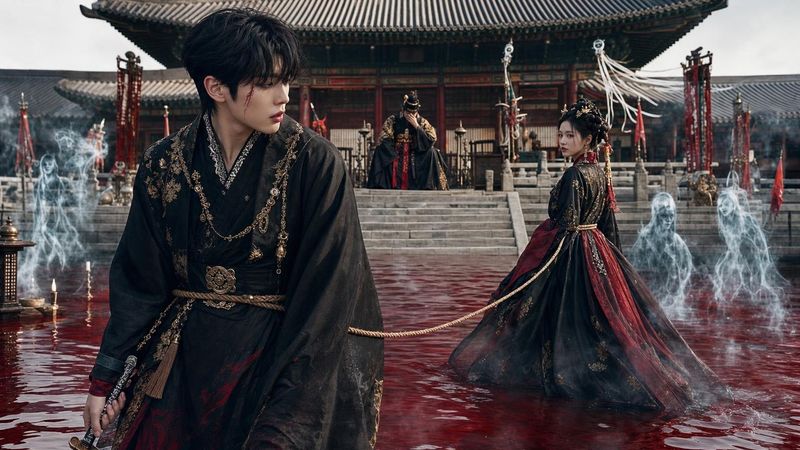
The official poster captures that idea in one image. Gu-cheon stands in crimson water, bound by a thick rope held by Saeng-gang, while the king watches from the palace steps above. It suggests that all three characters are trapped in the same crisis, even if they hold very different kinds of power.
The East Palace does not need to become the next Sweet Home to matter. Its lasting value is in showing how a global Netflix K-drama can make Korean folklore, royal tragedy, and occult horror feel accessible while preserving the cultural logic that makes its ghosts unsettling in the first place.