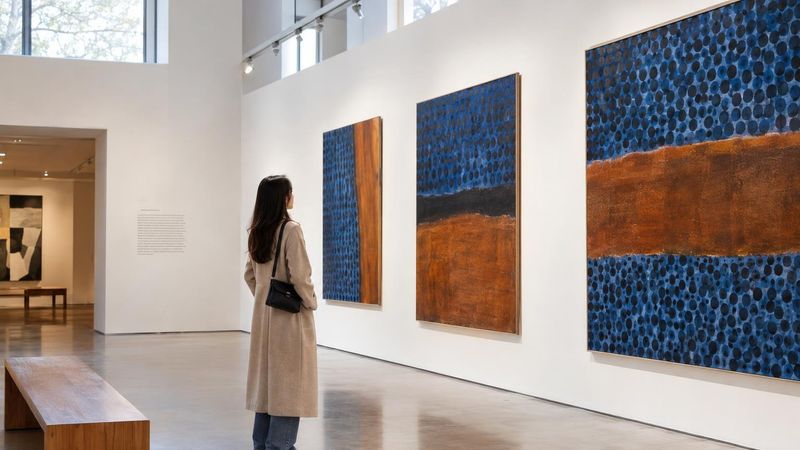
RM has been collecting art for about eight years, mostly out of view, and the results of that habit now fill the seventh floor of the San Francisco Museum of Modern Art. RM x SFMOMA: Between You and Me is the first museum exhibition built from his personal collection, and the first time the BTS leader has entered a museum as a co-curator rather than a visitor.
The show opened to the public on October 3, 2026, and runs through February 7, 2027. It places 142 works from RM’s holdings beside 36 from SFMOMA’s, for 178 pieces on display from a collection that numbers more than 400. It answers a question fans have asked for years: what does he actually look at?
Why RM x SFMOMA Is Not a Celebrity Display Case
SFMOMA approached RM with the idea of an art show about two years before the opening, and the project became a real co-curation with two museum staffers: project manager América Castillo and assistant curator of painting and sculpture Hyoeun Kim.
RM’s fingerprints are on nearly every part of it. He wrote the wall text and art labels in English and Korean, narrated the audio guide available on SFMOMA’s website, assembled a gallery playlist and titled the entrance wall in his own handwriting. A line on the floor reads, “Plz take it in with your eyes and heart.”
The scale separates this from a typical celebrity side project. SFMOMA calls it one of the largest presentations of Korean modern and contemporary art convened in the United States, and Hyoeun Kim describes it as the museum’s largest-ever presentation of Korean art. Works on view span the 13th century to the present day.
At the preview, RM admitted the moment got to him. “I think I revised this speech about 10 times, but somehow the more I worked on it, the more confused I became, like always,” he said. “This exhibition is a pretty long introduction of myself.”
The Artists at the Heart of RM’s SFMOMA Art Collection
Kim Whanki opens the show. His 1970 dot painting 26-I-70 has belonged to SFMOMA since 1979, when the artist’s widow, Kim Hyang-an, donated it, giving the museum its first real link to modern Korean art. RM cited that backstory in his handwritten reply to the museum’s original pitch, and calls Kim “the very first name I fell for.” His own 15-VII-70 #181 (1970) hangs nearby. That painting sold at Seoul Auction in 2019 for 630 million won, about $464,650, though RM’s purchase date is not publicly known.
Yun Hyong-keun has a gallery of his own, with 16 works. A leading figure of dansaekhwa, the Korean monochrome painting movement of the 1970s, he is best known for stacking bands of ultramarine and burnt umber on raw linen, a pairing he likened to the gate of heaven and earth. He was arrested four times for political reasons and imprisoned in 1973 after speaking out against corruption at the school where he taught.
RM has linked himself to Yun before. The cover of his 2022 solo album Indigo is Yun’s 1972 painting Blue, and the lead track, “Yun,” a collaboration with Erykah Badu, opens with the artist’s recorded voice.
Two more Korean modernists carry quiet weight. Chang Ucchin painted magpies, cows and small houses, and his Road (1986) hangs in a room styled like a living room. Yoo Youngkuk turned mountains into pure color and shape, and his Work (Trees) (1981) is in the show. “The mountain is not in front of me but inside of me,” he once said, a line carved on his tombstone.
How the Curators Hung Korean Art Beside the World
The exhibition is not organized as a national showcase. Korean artists are hung with international ones around shared questions of color, form and memory, and the 36 SFMOMA works give RM’s pieces context rather than decoration.
Kim Whanki’s blue dot paintings appear with Yves Klein’s Sponge (SE 251) (1961) in the section called “Bluewater,” two different routes to the same infinite blue. In “Home,” To Sangbong’s Forsythia (1975) sits near Giorgio Morandi’s Fiori (1949), a pairing built on the extraordinary inside the ordinary.
The sharpest dialogue may be Yun beside Mark Rothko. Rothko’s No. 14 (1960) hangs near Yun’s untitled (1986-90), and in the exhibition pamphlet RM writes that the two are often compared even though their darkness differs: Rothko’s “opens,” while Yun’s “is the darkness that remains after he endured everything he possibly could.”
Yun’s Burnt Umber and Ultramarine (2001) also sits beside Donald Judd’s To Susan Buckwalter (1964). The two artists met in 1991, and Judd later championed Yun’s work abroad. Kim Tschang-yeul’s Waterdrops (1978) appears with Tony Feher’s It Seemed a Beautiful Day (2002), two works about memory and loss.
Castillo says she hopes the show reaches people who have not felt at home in museums. “I’m excited about who this might bring into SFMOMA, including those who may not have felt spoken to by traditional art history frameworks,” she said.
“Namjooning” Comes Inside the Museum
Fans have a name for RM’s slower way of living: “Namjooning,” shorthand for museum visits, nature walks, reading and noticing small things. His songs “Yun” and “Still Life” grew from the same habits.
The effects show up in concrete ways. Bay Area fan Bre Walker had never been to an art museum before the show, and left feeling that museums could give her something. Another visitor, Sara Larios, flew in from Zambia, where she had organized fans to walk through the National Museum on RM’s birthday.
ARMY kept its traditions too, handing out handmade freebies outside the museum, from postcards and stickers to a door hanger reading “Do Not Disturb: Namjooning In Process.” “It’s like you’re making art in response to the art,” fan Joi Karra said.
The museum’s retail team is bracing for the same energy. “This is hands down the most inventory that we’ve ever front-loaded for an exhibition,” said Shane Salvata, SFMOMA’s director of retail.
From Museum Visitor to Co-Curator
The exhibition looks like an overnight arrival. It is not. RM’s collection grew over about eight years, a stretch he traces to visiting the Art Institute of Chicago, and continued through museum stops on tour. In 2023 he narrated the audio guide for LACMA’s The Space Between: The Modern in Korean Art and quietly lent six works to a Chang Ucchin retrospective in Korea. Three years later, he lent Yoo Youngkuk’s Work (1968) to a Seoul Museum of Art retrospective under his own name.
The throughline is a feeling RM has described across his solo records, from mono. to Right Place, Wrong Person. “I still feel like I’m always drifting and floating somewhere, whether I’m in the US or even when I’m in Seoul, where I was born and raised,” he said. “I’ve leaned on art a lot because of that feeling.”
He also resists the curator label. “I’ve never formally studied, and I’m not a ‘curator, curator,’ but in any field sometimes an outsider can bring in a new breeze,” he said.
What to See First, and What Comes Next
Four stops carry most of the story on a first visit.
- Kim Whanki’s 26-I-70 beside Yves Klein’s sponge painting in “Bluewater,” the section that opens the exhibition.
- Yun Hyong-keun’s gallery of 16 works, followed by the nearby Rothko.
- Chang Ucchin’s Road in “Home,” hung like a living room.
- The seven carved wooden ducks in “Friendscape,” read by some fans as a nod to BTS’ seven members.
The show stays on Floor 7 through February 7, 2027, and the audio guide is online in English and Korean. A second gift shop on the museum’s bottom floor sits outside the ticketed areas.
What comes after is still open. SFMOMA has not said whether the exhibition will travel, and RM has not announced another curatorial project. For now, a collection he once kept at home is on public view, with his handwriting on the walls.