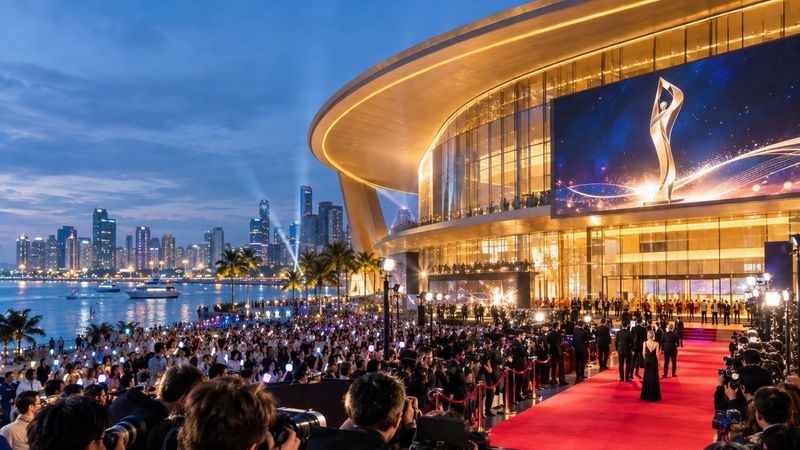
Busan International Film Festival opens its 31st edition on Oct. 6, beginning a 10-day run through Oct. 15 at the Busan Cinema Center and venues across the South Korean city. It is the first edition held since the International Federation of Film Producers Associations named BIFF an A-list festival, the tier reserved for the circuit’s most established events.
That recognition puts Busan in the same FIAPF tier as Cannes, Berlin and Venice. It arrives with a second upgrade: the winner of the festival’s top Busan Award can now be submitted for the Academy Awards’ Best International Feature Film category. Together, the two changes reshape how the festival works for filmmakers, distributors and viewers far outside Korea.
How the 2026 edition takes shape
Organizers selected 247 films from 59 countries for this year’s slate, the biggest since 2019. Of those, 95 will hold their world premieres in Busan. Add the 69 films programmed by Community BIFF, the audience-driven event in the Nampo-dong area, and total screenings reach 316.
The Competition section, introduced in 2025, returns with 14 shortlisted titles from South Korea, Japan, China, Indonesia, Iran, Taiwan and Uzbekistan. A seven-member jury led by Chinese director Zhang Yimou will choose the winners. Kim Min-ha hosts the opening ceremony, Yim Si-wan hosts the closing ceremony, and Kim Jong-kwan’s new film opens the festival with a cast that includes Kim Min-ha.
Festival organizers also moved opening day from Wednesday to Tuesday. Executive Chairman Jeong Han-seok said the decision followed audience habits. “We considered that most audiences plan their visit and viewing schedules during the first week after the opening,” he said, adding that the goal was to broaden viewing plans for people visiting the venues.
What “A-list” really means
FIAPF has used accreditation to signal a festival’s standing for decades, and a rule change finally worked in Busan’s favor. The federation retired its long-standing practice of sorting festivals by whether they run a competition section. In its place, a new framework evaluates two years of data across four areas: programming capability, industry activity, media and publicity impact, and audience reach.
That reform is the most significant restructuring of the system in roughly 20 years. Under the old rules, BIFF sat in the “Competitive Specialised” category, structurally separate from the top tier even as it grew into Asia’s largest festival. In March 2026, FIAPF elevated it to A-list status, making BIFF one of 17 A-list festivals among 49 accredited festivals worldwide and the only Korean festival at that level.
The label is not the same as equal market power. Just as it took decades for the Palme d’Or to carry authority that shapes distribution and box office, Busan’s awards will need time to build comparable weight. The festival’s next challenge is moving from a platform that introduces Asian cinema to one that helps define which Asian films the world pays attention to.
The Oscar route, explained
The Academy of Motion Picture Arts and Sciences added BIFF to a short list of six festivals whose top prize winner becomes eligible for submission in the Best International Feature Film race. For the festival, that is a formal doorway into awards season rather than a guaranteed spot on the ballot.
Eligibility is not a nomination. A country’s submission committee still decides what it enters, and Academy voters still decide what makes the shortlist. What changes is that a Busan Award win now carries a documented path toward the Oscars, giving the festival’s jury a stake in the race it did not have before.
The market where deals happen
Red carpets draw cameras, but the Asian Contents and Film Market is where the festival’s influence on what viewers eventually see gets decided. The 21st edition runs Oct. 10 to 13 at BEXCO, with 64 programs across seven sections covering intellectual property trading, investment and distribution, cinematic AI and new media.
The market sits alongside the Asian Project Market, the Busan Story Market and InnoAsia, a structure that spans development, financing and delivery. Deals made among investors and distributors in Busan feed into release plans that reach US theaters and streaming platforms later.
Busan is also pushing the festival deeper into the city. Neighborhood BIFF, the program that places screenings in residential districts, expands to 17 areas including Yangsan and Seoul.
The stars US audiences know
This year’s guest list leans on names that travel. Michelle Yeoh, the first Asian to win the Academy Award for Best Actress, returns to Busan after 15 years to accept the Asian Filmmaker of the Year award. Hong Kong director Ann Hui receives the Camellia Award for her work empowering women in film.
Alfonso Cuaron makes his first visit to Korea, while Maggie Gyllenhaal, Isabelle Huppert, Zhou Xun and Fan Bingbing are also set to attend. Director Lee Chang-dong’s Possible Love, which won the Grand Jury Prize at the Venice International Film Festival, was invited to the Icons section.
Followers of Korean television have their own reasons to watch. The Actors House series puts Kim Go-eun, Kim Min-ha, Ryu Seung-ryong, Shin Min-a and Ju Ji-hoon in front of live audiences. The On Screen section showcases series including The Remarried Empress, Sweet Part-time Job and Blue Road, and Yeon Sang-ho’s Hellbound was invited to the Gala Presentation lineup.
What to watch after Oct. 15
Winners will be announced before the festival closes, and the market’s business continues to shape which titles land distribution deals. For US viewers, that follow-through matters more than any single red carpet moment.
Busan’s mayor, Jeon Jae-soo, framed the edition as part of a wider cultural push. “Building on the strength we have accumulated over 30 years, we have established ourselves as a festival the world is watching,” he said.
The open question is whether A-list status translates into lasting influence. A festival can hold the label and still struggle to shape which films travel beyond Asia. Busan’s coming years will show whether its awards, its competition section and its market carry the weight of the festivals it now sits beside.